
Sophisticated Oil Refiner Implements Oil Skimming to Ensure Cost-Effective Environmental Compliance
 Environmental compliance is always a challenge for refineries. Since 1976 no new refineries have been built in the United States due to the implementation of strict legislation mandating refineries meet rigorous air and water cleanliness requirements. In order to stay cost-effective as well as meet demand, many facilities have had to turn to expansion which has led to an industry abundant with acquisitions and mergers.
Such is the case with the Montana Refining Company, a 10,000-barrel-a-day crude oil refiner purchased by world leader Connacher in 2006. Like other large-scale plants with high capacity, process optimization and advanced process controls are very desirable at Montana Refining.
Stephen Kind, a reliability engineer at the Montana Refining Company for the past 18 years, says the company’s No. 1 goal is “to produce fuels as economical and environmentally friendly as possible.”
The Need to Recapture Oil from Wastewater
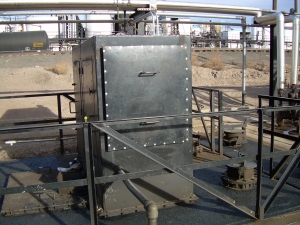
Montana Refinery is a sophisticated plant capable of producing everything from gasoline to jet fuel to asphalt. So when Kind went looking for a reliable method of capturing and transferring oil from the plant sewers before sending water to the city’s wastewater facility, he went on the Internet. That’s where he found the MB 5 x 8 Oil Grabber System from Abanaki, a leading oil skimmer manufacturer.
Oil skimming is an efficient and cost-effective solution used by wastewater engineers across many industries. The oil skimmer works with wastewater collection and treatment systems designed to ensure that water running through the plant is suitable either for reuse or disposal. It was the unit’s reputation for removing large amounts of hydrocarbons with no water pickup that appealed to Kind. Before installing the Abanaki oil skimmer, hydrocarbons had been skimmed using an adjustable horizontal slotted pipe that was rolled by hand. Overtime operating costs were increasing because of the labor-intensive requirements of these kinds of methods, becoming further compounded by the amount of water recovered that then must be treated or disposed of as hazardous waste.
How Oil Skimming Works
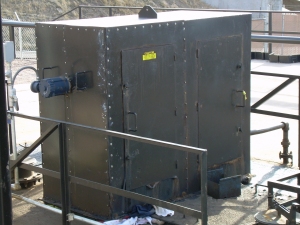 Oil skimming makes use of the differences in specific gravity and surface tension between oil and water. These physical characteristics allow the Oil Grabber to attract oil and other hydrocarbon liquids from the surface of the fluid efficiently and cost effectively. Kind further ensured that oil would be removed at high rates by choosing a version of the unit that is built specifically for jobs requiring high capacity oil removal. The 5 x 8 version features five belts made of Abanaki’s Fuzzy Belt® material. Not only do the multiple belts deliver ten belt surface skims simultaneously, their revolutionary material was patented by Abanaki to offer exceptional oil skimming performance on light, non-viscous hydrocarbons, such as gasoline diesel, and jet fuel, where rate of recovery is an important factor.
As a result, the continuous oil skimmer belt and wiper action of the Model MB 5 x 8 removes up to 200 gallons of oil per hour from the water surface. The oil skimmer belts, operating on a motor and pulley system, run through the contaminated liquid to pick up oil from the surface. After traveling over the head pulley, the belts pass through tandem wiper blades where oil is scraped off both sides of the belts and discharged.
Abanaki also designed the unit to be an easy install without tank modification and with virtually no maintenance issues. The tail pulleys have flanges, which allow them to roll freely on the inside of the belts without becoming dislodged. They require no bearings and do not need to be fastened to the tank. If turbulent conditions exist, an optional tether and cage assembly prevents the tail pulleys from being dislodged in almost any depth, from a shallow one-foot up to 100 feet.
In fact, everything about the Oil Grabber MB Model 5 x 8 oil skimmer is designed to last for many years. With proper configuration it can handle liquid temperatures up to 212°F, and the pH of the fluid can range from 3 to 13. The skimmer drive includes an oil-filled gear reducer with bronze gears and ball bearings. The motor, reducer, and powder-coated finish of the weldments give the unit an exceptionally long life, even under the harshest conditions.
Successful Recapture of All Hydrocarbons
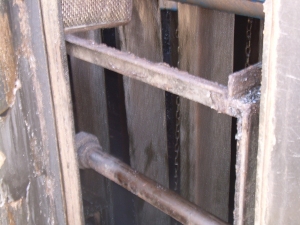 “Everyone seems to be impressed with the process. There has been no maintenance on it since we leveled it. Bart Eggert, [Abanaki’s regional account representative] was very responsive to our questions and extremely helpful in trouble shooting any installation problems we had,” Kind says.
“We recapture 100 percent of all hydrocarbons that go down our drains,” Kind confirms. “The sewer systems of the refinery go to a collection pit where we have the skimmer mounted. The skimmer collects the hydrocarbons and they are sent back to our crude tank.”
“We leave the skimmer on 24/7. If we can’t transfer the oil for some reason we open a by-pass valve and let the oil go back to the pit until our secondary containment pit can be pumped,” Kind says. Kind said that the system is a great time saver. Operations does not have to baby-sit the skimmer. Labor savings more than offsets the cost of electricity and less water is transferred to the break tank. Oil skimming has proven to be a cost-effective means of environmental compliance.