
 Oil Skimming Informational Guide
What is an Oil Skimmer?
An oil skimmer is a machine that removes floating oil and grease from liquid. Specifically, the floating oil adheres to skimming media, such as a belt, tube, rope, mop, or disk. Then, the media runs back to the machine to be wiped clean. Additionally, weir style skimmers use a pump to collect floating oils.
An oil skimmer is a mechanical device designed to remove floating oil from the surface of water or other liquids. Because oil is lighter than water, it rises to the surface — and that’s where skimmers do their job.
Whether in an industrial sump, a coolant tank, or an open body of water after a spill, oil skimmers help separate and recover this surface oil for reuse or disposal. Consequently, this process not only keeps systems clean but also prevents environmental contamination and regulatory violations.
Related Articles:
- Exploring the Depths Between Belt Skimmers and Tube Skimmers for Effective Oil Removal
- Key Factors for Selecting the Ideal Belt for Oil Skimmers
- 11 essential Tips for effective Oil Removal
- Enhancing CNC Machine Performance With Oil Skimmers
- Choosing an Oil Skimmer by Removal Capacity
- The Pitfalls of Under-Sizing Your Oil Skimmer
- Key Tank Characteristics to Consider
- Different Types of Oil Skimming Machines
Oil Skimmer Product Categories:
Oil and Water Don’t Mix
The relationship between oil and water in a mixture is well-known and governed by two physical properties:
Specific Gravity
Most hydrocarbons have a lower specific gravity than water. As a result, without agitation, oil separates from the water and floats to the surface. These oils are known as LNAPLs, Light Non-Aqueous Phase Liquid. In contrast, oils (and other compounds) that sink in water have a higher specific gravity and are known as DNAPLs, Dense Non-Aqueous Phase Liquid.
Surface Tension and Affinity
Normally, oil bonds more tightly to itself and other materials than to water. Consequently, this affinity, and differences in surface tension between oil and water, cause oils to adhere to a skimming medium.
Article: How Do I Remove Oil from Water?
Oil Skimming
 Although designs vary, all oil skimmers rely on specific gravity, surface tension, and a moving medium to remove floating oil from a fluid’s surface.
Consequently, floating oil and grease cling to skimming media more readily than water, and water has little affinity for the media. As a result, this allows skimming media in the shape of a belt, disk, drum, etc. to pass through a fluid surface to pick up floating oil and grease with very little water. This oily material is then subsequently removed from the media with wiper blades or pinch rollers.
Overall, oil skimmers are simple, dependable, and effective tools for removing oil, grease, and other hydrocarbons from water and coolants. In many cases, an oil skimmer by itself can achieve the desired level of water purity.
However, in more demanding situations, oil skimming is a cost-effective means of removing most of the oil before using more complicated and costly treatments such as coalescers, membrane filters, and chemical processes.
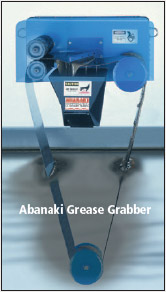
When it comes to grease skimming, it involves higher viscosity hydrocarbons. Oil skimmers must be equipped with heaters powerful enough to keep grease fluid for discharge. The patented Abanaki Grease Grabber® is fitted with heating elements to handle these applications.
If necessary, if the floating grease has formed into solid clumps or mats, a spray bar, aerator, or mechanical apparatus can be used to break up grease mats and facilitate removal.
Where are Oil Skimmers Used?
Oil skimmers are used in a variety of industries, from food processing to refineries. While the benefits differ among industries—from extending tool life to keeping within environmental regulations—the common factor is that all industries see a solid return on investment. Specifically, by removing oil from water, operating cost decreases from expenses like reduced labor and maintenance, increased regulatory compliance, less machine downtime, cleaner work environments, and more.
Wastewater Sumps
Most manufacturing or processing facilities have water systems where waste oil collects in a central tank or sump. Therefore, skimming the floating oils with little water content can reduce the cost of disposal and lower the contingent liabilities of wastewater discharge.
Coolants and Cutting Fluids
When machine coolants become contaminated with tramp oils, four things usually occur:
- coolant life is reduced;
- quality of machined parts is reduced;
- in many cases, a smoke will begin to appear in the shop, causing irritation to the workers on the job; and
- the fluid takes on a “rotten egg” odor. Oil skimmers that remove tramp oils solve these problems and typically pay for themselves within a few months.
Heat Treating
Quench oils that must be removed from heat treated parts can be captured for re-use or disposal. As a result, the outcomes are lower quench oil costs, prolonged wash water life, and lower disposal costs.
Parts Washers
Floating oils re-contaminate parts as they are removed from a wash tank. To prevent this, oil skimmers can remove this oil. As a result, the benefits of using an oil skimmer are oil-free parts and extended fluid life.
Food Processing Facilities
Removal of vegetable oils, greases, and animal fats from a plant’s wastewater stream reduces the costs of processing and disposal.
Steel Mills/Scale Pits
Most steel mills have scale pits in which grease and heavy oils accumulate. To comply with regulations, and in order to avoid fines from the government and expensive sand bed filters, steel mills must limit the amount of grease in wastewater discharged into the environment. Moreover, reclaimed grease and oil can be re-used or used as furnace fuel, thereby avoiding sucker truck disposal costs.
Parking Lots, Garages and Service Facilities
Waste oil from leaks, spills and other sources must be retrieved from sumps before water can be discharged to storm or sanitary sewers.
Outdoor Ponds, Lakes, Basins, Etc.
Where floating oils are present, oil skimmers provide inexpensive and effective removal, solving a serious environmental problem.
Recovery/Monitoring Wells
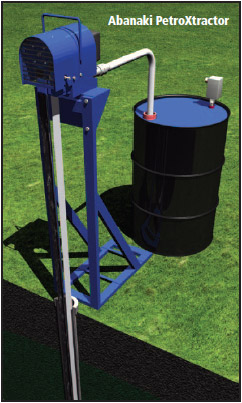
Removing oil, fuel, and other hydrocarbon liquid from wells can be more cost-effective using a belt skimmer instead of a down well pump. In addition, oil skimmers don’t have nearly the maintenance issues and can reach depths of 100 feet or more, removing product despite fluctuating water tables. Furthermore, oil skimmers can handle very thick fluids effortlessly, and some (like the Abanaki PetroXtractor®) can remove sinking DNAPLs such as coal tar and creosote from water.
Hydraulic Fracturing (Fracking)
Successfully remove oil found in fracking wastewater.
How Do you Choose the Right Oil Skimmer?
 There are several types of industrial oil skimmers. Therefore, choosing one best suited for your application will maximize oil removal while minimizing capital outlay and oil skimmer operating costs. First, define the application in terms of the following characteristics:
Operating Conditions
All oil skimmers have a moving medium, and possibly other parts, immersed in the liquid. Moreover, the performance and life of the pick-up medium, wiper blades, pulleys, etc. are affected by different conditions. These conditions include temperatures in and out of the liquid, pH of the solution, and the presence of solvents or other reactive chemicals.
Hazardous Materials
Specifically, applications involving flammable materials or explosive vapors require the use of explosion proof or air driven motors and controls.
Temperature/Viscosity
All oil skimmers require floating oil to be in a liquid, free-flowing state. However, if the oil congeals or solidifies at ambient temperatures, the tank and/or oil skimmer will require heaters to maintain fluid flow. This is especially true at temperatures low enough to freeze water. Therefore, a heater option is a must if an oil skimmer is to be used outdoors in freezing temperatures.
Removal Capacity
Capacity should be based on the maximum amount of oil to be removed within the shortest available time. For instance, total oil influx may be 200 gallons in a 24 hour period, which averages about 8.3 gallons per hour. However, if most of it comes during a single eight hour plant shift, you will probably need a removal rate that is three times as high, especially if you are trying to prevent an unwanted discharge of contaminated water to a sewer system. Therefore, as a rule-of-thumb, specify approximately twice the maximum capacity you anticipate needing for normal conditions.
Rating
Oil skimmers usually have an oil removal rate expressed in gallons per hour. However, the rate varies with oil viscosity, so Abanaki rates skimmers using SAE 30 weight motor oil at 65°F (18°C). Therefore, when specifying removal capacity, it is better to err on the high side to allow for peaks in the oil influx.
Water Content
All oil skimmers pick up some water with the oil they remove. In fact, some designs, particularly suction skimmers, pick up more water than others. Consequently, high water content increases oil recycling and disposal costs. Generally, the ratio of water-to-oil decreases with thicker films of floating oil and slower moving pick-up media.
Furthermore, an Oil Concentrator® or decanter installed at the oil skimmer discharge port provides secondary oil/water separation that can reduce water content to nearly zero.
Residual Oil
An oil skimmer continues to remove oils as long as they are present. Depending on oil influx rate and the oil skimmer’s removal rate, residual oil in the water may be as low as a few parts per million. However, when residual oil reaches this level and further reduction is required, it may be more practical to use a secondary removal method following skimming, such as membrane filtration.
Portability
Oil skimmer portability is a plus in some applications. For example, in plants, mobile equipment service shops, and at remediation sites, a portable oil skimmer can therefore sometimes service multiple machines, sumps, or wells.
Tank or Sump Characteristics
The location, shape, and capacity of a tank or water impoundment are major factors in choosing the right oil skimmer. Additionally, consider fluctuations in water level, turbulence, and possible emulsions. Although oil skimmers do not cause emulsions, they nevertheless can have trouble removing certain types.
Size/Design
Oil and water can emulsify when subjected to turbulence and other mechanical agitation. To avoid this, have water return to the tank below the liquid surface at as low a velocity as practical. Moreover, make sure your tank or sump provides quiet areas, weirs, and sufficient volume to allow adequate time for oil/water separation.
Shape
Tanks without nooks and crannies for oil to accumulate in are best. However, if you have an irregular shape, put the oil skimmer where the largest amount of oil accumulates. Also, consider a means of directing oil towards the oil skimmer such as a floating boom or baffle plate.
Location/Installation
The physical location and characteristics of the tank and collection container are important. For example, does skimmed oil need to be pumped from the oil skimmer to the container? Additionally, will oil skimmer access for periodic maintenance be a problem? Furthermore, how much mounting space is available? Also, are tank or container modifications required? In fact, cheap oil skimming systems quickly lose appeal when costs for additional components, increased maintenance, and expensive tank modifications are involved.
| Industrial Oil Skimmers | Special Purpose Skimmers | |||||||
| Small Applications | Medium Applications | Large Applications | Monitoring Wells up to 10″ | Large Pits | Harsh Environments | |||
| Removal Capacity | Light Duty | Medium Duty | Light Heavy Duty | Medium Heavy Duty | Heavy Heavy Duty | Groundwater Remediation | Heavy Oil or Grease | 316 SS Construction |
| Reach of Skimmer | Up to 2′ | Up to 5′ | Up to 100′ | Up to 100′ | Up to 100′ | Up to 100′ | Up to 100′ | N/A |
| 1 GPH |  |
|
 |
|
|
|
|
|
| 2 GPH | |
|
|
|
|
|
|
|
| 3 GPH | |
|
|
|
|
|
|
|
| 6 GPH | |
|
|
|
|
|
|
|
| 12 GPH | |
|
|
|
|
|
|
|
| 16 GPH | |
|
|
|
|
|||
| 20 GPH | |
|
|
|
||||
| 40 GPH | |
|
|
|||||
| 80 GPH | |
|
||||||
| 120 GPH | |
|
||||||
| 160 GPH | |
|
||||||
| 200 GPH | |
|||||||
Removal rates based on SAE 30 motor oil.
Grease Grabber removal based on Plexelene 750™.
Size of application must be taken into consideration for optimal recovery rates.
= Appropriate sizing.
= Capacity well above desired level.
What are the Different Types of Oil Skimmers?
In industrial applications, six fundamental oil skimmer designs are commonly used. Each design, in turn, is engineered to address specific operating conditions, fluid characteristics, and system requirements so as to ensure efficient and reliable oil removal.
- Belt Skimmers
- Disk Skimmers
- Drum/Barrel Styles
- Mop Skimmers
- Large Tube Skimmers
- Mini Tube Skimmers
- Floating Suction Skimmers
What is Belt Oil Skimmer?
Belt-type oil skimmers use an endless belt of corrosion-resistant steel or synthetic medium, which is lowered into the tank or vessel to be skimmed. Then, the belt passes through resilient wiper blades where the oil is removed from both sides of the medium. Overall, belt machines provide a simple, dependable, and cost-effective method for removing oil, grease, and other hydrocarbons from water.
What is Disk Oil Skimmer?
These oil skimmers rotate a disk-shaped medium through the liquid. Similarly, oil is wiped off and discharged into a collection container in a manner similar to belt oil skimmers. Therefore, it is important to consider reach, the portion of the disk that actually gets immersed, when looking at a disk oil skimmer. In fact, less disk in the fluid means less oil removed. Obviously, fluctuating fluids can be a real problem for disk oil skimmers.
What is Drum/Barrel Styles Oil Skimmer?
These are similar to the disk-type, but use a rotating drum-shaped medium. In comparison to disk types, they are usually more rugged and have higher removal capacity. However, depending on the design, these units can also be rendered ineffective by fluctuating fluid levels. Additionally, water pickup with this type of oil skimmer can be high.
What is Mop Oil Skimmer?
These oil skimmers use an endless medium shaped like a rope and having mop-like tendrils that pick up the oil. As the medium leaves the liquid and enters the drive unit, it is pressed and wrung out with pinch rollers. However, for higher viscosity oils, the medium tends to mat down and lose effectiveness. Therefore, a decant system is a must for these units, as water pickup can be very high. Moreover, replacement oil mops can be very expensive, so check prices on replacements before purchasing.
What is Large Tube Oil Skimmer?
Tube oil skimmers use a floating plastic hose that snakes out over the surface of the liquid and is then drawn back through the drive unit where oil is removed. However, this design requires a relatively large amount of surface area for proper operation. On the other hand, this oil skimmer can skim from very shallow tanks. Generally, the removal capacity is lower than belt, drum, or mop type oil skimmers.
What is Mini Tube Oil SKimmer?
Very similar to the large tube units, but use either a 3/16″ or a 5/16″ tube instead of 1″. Consequently, the pickup rate varies from 1 quart/hour to 1.5 gph depending on the diameter of the tube. Additionally, these units are fairly compact and can fit in tight spots. Furthermore, the better units will have the motor mounted underneath, to bring room required over the lip of the tank down to near zero. Overall, the 5/16″ diameter tube is preferable as it has a 1 gph removal capacity and enough stiffness to not drag on the housing and prematurely wipe off oil when being drawn into the unit.
What is Floating Suction Oil Skimmer?
These come in several forms, but all have a floating intake. They are therefore most suitable for relatively thick layers of oil (1/4 inch or higher); otherwise, they tend to ingest large amounts of water. In fact, some machines will actually emulsify oil due to churning as it passes through the suction pump. Consequently, this type of oil skimmer requires a coalescing or at least a decanting unit to be at all effective. The standard drive on all units is an electric motor and gear reducer. However, other drive types are available.
Abanaki Oil Skimmer Models
Oil Skimmer Belt and Tube Length
Removal capacity is not affected by length. Therefore, choose a length that: assures contact with the liquid at its lowest level; allows easy mounting of the oil skimmer where oil discharge is convenient; and has good access for routine service. Moreover, Abanaki’s ability to supply oil skimmers with long belts, and lift skimmed oil well over 100 feet with no loss in capacity or efficiency, is important to many users.
Disk Diameter
The disk must always be touching the fluid. Size the diameter accordingly.
Wiper Blades
Abanaki offers 4 wiper blade materials for a variety of operating environments. Firstly, the standard is Nitrile (also known as Buna-N), which is appropriate for about 80% of all applications. Additionally, optional materials are designed for applications with harsh operating conditions. These materials include CRV (very high chemical resistance), ceramic hybrid (excellent lubricity and moderate chemical resistance), and stainless steel wipers.
Motor Types
All Abanaki oil skimmers are designed with standard, industrially rated, continuous duty motors and fully enclosed speed reducing drives. Furthermore, most of these oil skimmers can be specified with the following motor options:
- Any standard or exceptional electrical requirement
- Explosion proof
- Drip proof
- Tropicalized
- Dirty duty
- Food service
- Wash down duty
- DC motors
- ATEX/European motors
Contact Abanaki regarding availability of special motors, controls and drive components to satisfy unusual requirements.
How Do You Choose the Right Belt Material for Your Oil Skimmer?
Five different belt materials are offered by Abanaki to meet different industry needs. Below, the chart indicates which material is most suitable for different situations. However, belt performance and durability depend on the nature of the liquid, chemical composition, and temperature, so be sure to test the material before purchase. Fortunately, Abanaki offers free samples of belt material for test purposes.
|
Materials |
|||||
| Belt Capabilities | CR Steel |
Elastomer | Poly | XP-Poly | Fuzzy |
| Temp Range | <220°F (104°C) | <120°F (49°C) | 160°F (71°C) |
<180°F (82°C) | <160°F (71°C) |
| pH Range 2-13* | Yes | Yes | Yes | Yes | Yes |
| Operates in the presence of grit fines and other suspended particles |
No | Yes | Yes | Yes | No |
| Removes certain DNAPL’s and some emulsified oils |
No | No | Yes | No | Yes |
| Effective for every light oils | No | No | No | No | Yes |
*At ambient temperatures.
Optional Equipment
Abanaki accessories make it easy to customize your oil skimming system for quick installation and optimal performance. For example, listed below are the most commonly requested items. Additionally, more specialized accessories are available on request.
Solar Oil Skimming System
Choose from several pre-engineered mounting stands for easier installation. Specifically, models are available for pits, walls, and free-standing units. Moreover, handy storage stands are available for portable units. Finally, all stands are shipped fully painted and ready for quick assembly.
Transfer Package and Underground Oil Skimming System
This option is for applications in which the oil storage tank is far from the point of oil removal or for below ground applications. Specifically, this turnkey system consists of a small collection tank, a pump, small control panel and three float switches. The oil that the oil skimmer picks up is deposited to the collection tank. Then, when the collection tank is full, the middle float switch signals the pump to turn on. Finally, the oil is then pumped to your storage tank or facility for permanent removal or storage.
Controls/Accessories
Abanaki offers a float switch and warning light combination to monitor fluid level in the skimmed oil collection drum, which helps prevent overflow. In addition, other electrical options include timer, heater, and control panel. Furthermore, Abanaki also offers poly shelters and discreet secure enclosures as well as a variety of mounting options for the oil skimmer.
Concentrators: Abanaki Oil Concentrators® provide a secondary separation step after oil skimming to virtually eliminate water from skimmed product. Moreover, units are available for easy installation on most Abanaki oil skimmers.
Oil Skimming Frequently Asked Question
How Efficient Is an Oil Skimmer?
Oil skimmers are a simple and effective way to remove oil from water. They can recover 90–95% of the oil with very little water mixed in. Their performance depends on the type of oil, skimmer design, and how they’re used. Recovering oil is important in many industries like metalworking, wastewater treatment, and food processing. If oil builds up in coolants or water, it can cause bad smells, damage equipment, raise costs, and even lead to fines. Using an oil skimmer helps prevent these problems while saving money and protecting the environment. Continue Reading.
Which Types of Oil Skimmers Are Commonly Used in Machine Shops?
In machine shops, common oil skimmer types include belt, disk, and tube oil skimmers. Belt oil skimmers are the most popular due to their reliability and ease of use, while disk and tube oil skimmers are good options for smaller sumps or tighter spaces. All three help remove oil from coolant, keeping machines running efficiently and extending coolant life. Find out more.
Best Ways to Remove Oil from Water in Industrial Settings?
Removing oil from water is a common challenge across many industries. Effective solutions include using oil skimmers, coalescers, and filtration systems designed to separate oil from coolants and wastewater. One reliable method is employing an Abanaki oil skimmer, which efficiently removes oil, reduces disposal costs, and extends coolant life. Find out more.

Abanaki Corporation Oil Skimming Division
17387 Munn Road
Chagrin Falls, OH 44023
Phone: (440) 543-7400
Email: skimmers@abanaki.com
Fax: (440) 543-7404
ISO 9001:2015 Certified Company