
Abanaki Corporation Oil Skimming Division
17387 Munn Road
Chagrin Falls, OH 44023
Phone: (440) 543-7400
Email: skimmers@abanaki.com
Fax: (440) 543-7404
ISO 9001:2015 Certified Company
Terms and Conditions

Abanaki Corporation Oil Skimming Division
17387 Munn Road
Chagrin Falls, OH 44023
Phone: (440) 543-7400
Email: skimmers@abanaki.com
Fax: (440) 543-7404
ISO 9001:2015 Certified Company
Terms and Conditions
Tramp Oil Collection: Coalescers vs Oil Skimmers | Abanaki
Multiple options exist for the collection of tramp oils. Two of the most common are oil skimmers and coalescers. Both offer unique advantages and disadvantages in certain applications.
Coalescers
Coalescers focus on collecting oil into larger droplets. Using a filter medium, the oil is gathered into one place and combines into a larger oil droplet, heightening the differing densities of oil and water. The oil then floats to the top of the coalescer, allowing removal by other means.
Coalescers have an advantage in specific coolant-related applications. Coalescers cover a bigger collection area than oil skimmers, speeding recovery and reducing need for moving the oil collection device.
Unlike oil skimmers, coalescers have no need for a collection container, preventing the potential for spillage. Abanaki’s Oil Boss can also be hung from a metallic surface, preventing the floor space footprint of other coalescers and oil skimmers.
Oil Skimmers
Oil skimmers focus on removing tramp oils using oleophilic belts. These belts attract the tramp oils and drag them up to a trough where they are scraped off, removing them from the water or coolant. Different belts have different specialties, such as steel belts being suited for LNAPLs and tramp oils.
In addition, oil skimmers do not have to worry about pumps clogged by shavings or solid byproducts like coalescers might. Dirty oil can also go back into the sump in coalescers, while oil is completely removed by a oil skimmer. Oil skimmers also have more applications than coalescers, such as environmental remediation.
For more information about our line of coalescers and oil skimmers, contact us via phone at (440) 543-7400 or via e-mail at skimmers@abanaki.com.
Read more
The Next Generation in Oil Skimming | Abanaki
Abanaki’s Oil Boss with “Constant Flow Facilitator”
Abanaki’s Oil Boss oil skimmer provides cost savings by removing unwanted tramp oil prolonging the life of the coolant. The patent-pending Oil Boss is designed for CNC machines offering passive tramp oil removal. This high-capacity-unit constantly removes and discharges unwanted oil from the coolant. The unit uses a specially-designed “Constant Flow Facilitator” automatically discharging the tramp oil as it is collects on the coolant. The “Constant Flow Facilitator” eliminates the need to remove oil manually.
Magni-Cling Technology Oil Skimmer
Oil Removing Process with Abanaki Oil Boss
Oil laden fluid is pumped up from the sump through the inlet valve of the Oil Boss. From there, the fluid passes through a media system, slowing the flow and allowing the oil to be filtered. The clean fluid passes through a second chamber and back to the sump below, leaving your tank with cleaner fluid in no time at all! The filtered oil can be easily discharged for clean and easy removal. In some instances, companies may be able to re-use the skimmed oil elsewhere or sell it for recycling, choosing to keep their part of the world cleaner. The Oil Boss is also reversible, which allows it to work within the layout of your shop without tubes and cords becoming tangled. The sleek design allows for simple, efficient, and clean oil removal.
Advantages of Abanaki Oil Boss
The Oil Boss is an innovative tool that keeps coolant free of oil and ultimately extends tool and coolant life. Additionally, it reduces expenses that would typically be used on maintenance and disposal.
Read more
Oil Skimmers Help Steel Mills Save Money | Abanaki
There is likely no larger industrial meeting place for oil and water than a steel mill. Because of the massive amount of water that is needed for process cooling and descaling, and the similar quantity of hydraulic, lubricating, and cooling oils that are required in steel production, the adage that oil and water do not mix is put to the test and proven every day.
Oil contamination in steel mills process water
It can take between 10,000-75,000 gallons of water to produce one ton of steel, depending on the amount of recycled water that is used. Reusing water whenever possible is crucial to maintaining costs, and to be able to reuse water in the majority of steel mill processes it needs to be free of contamination, namely oil.
Tramp oils commonly contaminate steel mill process water and this can lead to a variety of problems. Water purity is obviously affected which means that the effectiveness of this water in its role as a coolant or lubricant is reduced. Additionally, water that is contaminated with oil cannot be discharged into a facility’s wastewater system, as this can potentially cause a hazard to the environment. Finally, the presence of some oils in water can provide an ideal media for bacteria growth that can present unsafe working conditions for workers. All of these factors contribute to a mill not being able to recycle water, which means increased production costs.
Abanaki Model 8 Oil Skimmer
Depending on the characteristics of the liquid, it is possible for the Model 8 to reduce oil content to less than five parts per million in water. It utilizes a continuous belt and wiper to remove up to 40 gallons of oil per hour from the fluid surface. The unit can be used as a pre-treatment before filtration, and in conjunction with coalescing systems. The versatility of the Model 8 allows it to be used in a wide array of applications in addition to steel mills, such as:
Abanaki Model 8 Oil Skimmer Specifications
The Model 8 can be used in tanks with depths as shallow as one foot, or as deep as 100 feet, and is built to last. With the proper configuration it can handle liquid temperatures up to 212°F, and the pH of the fluid can range from 3 to 13. The skimmer drive includes an oil filled gear reducer with bronze gears and ball bearings. The motor, reducer, and powder coated finish of the housing give the Model 8 exceptionally long life, even under the harshest conditions.
Read more
Don’t Choose the Wrong Belt Material | Abanaki
Selecting the right belt material is just as important as selecting the right skimmer. Choose the wrong belt and the skimmer will not work correctly. Things like pH, temperature, and oil type are crucial considerations.
Purpose of Oil Skimmer Belts
Selecting the right belt material is just as important as selecting the right skimmer. You might choose the right skimmer but the wrong belt type and the skimmer will not work correctly to solve your oil in water problem. It is crucial that things like pH, temperature, and oil type are considered when selecting a skimmer AND a belt type.
A belt is to a skimmer like wheels to a car’s chassis: although the latter is the most identifiable part, it needs the former to actually run. Just like tires, belts are not one size fits all. Just as there are snow tires, street tires, year-round tires, and more, so too are there a variety of belt materials. So, what purpose does each serve?
Different Kind of Oil Skimmer Belt Materials
Steel Belts
Steel belts are the standard for many applications. Their durability, corrosion resistance, and strong oleophilic tendencies make the material effective in most scenarios. The lower price and ease of welding also reduce costs. The biggest caveat is their ineffectiveness when confronted with rust inhibitors in wash water. Steel belts are also ineffective in most applications where Petro-Xtractors are used.
Elastomer Belts
Elastomer belts are an alternative to steel belts that perform well in a multitude of situations. These belts can handle some of the harshest, most abrasive conditions a skimmer can be placed in and are fully compatible with the Petro-Xtractor. Still, steel belts will not stretch when exposed to UV rays over a long period of time.
Polymer (Poly) Belts
Polymer belts, commonly shortened to poly belts, are meant for higher temperatures and conditions where UV exposure and rust inhibitors are an issue. The textured nature of the poly belts causes more oil than usual to be picked up. This option tends to be pricier, but works like a charm in intense functions.
Fuzzy Belts
This video demonstrates how choosing the right belt material makes all of the difference. The Fuzzy belt does a better job at picking up the hydrocarbon than the standard belt on the right.
LFO belts, commonly referred to as Fuzzy belts, are a proprietary skimmer belt exclusive to Abanaki. This material specializes in the rapid removal of light, non-viscous hydrocarbons from water. If your problem is an oil like gasoline, the Fuzzy belt will remove it much more efficiently than any other belt in normal conditions. The Fuzzy belts are also extremely resistant to stretching.
XP Polymer (Poly) Belts
XP polymer belts, commonly shortened to XP poly belts, are very similar to poly belts. The key difference comes in its texture and temperature resistance. The XP poly belt is better able to handle high temperatures, maxing out at 180ºF. The belt also has a smooth texture rather than the ridged design of the standard poly belt. Although this change means the XP poly belt will not pick up oil as quickly, the belt will function better than the standard poly belt in conditions that would wear away the ridged design.
More information can be found in the Abanaki Oil Skimmer Factbook or Abanaki Belt Selection Guidebook. It is best to call (440-543-7400) with details of the application and ask your Abanaki representative what will work best with your belt skimmer.
Read more
Abanaki Mighty-Mini Oil Skimmer Can Extend your Coolant Life and Save you Money
So, is your product quality being affected by floating oil? Have you asked yourself how you remove oil from water effectively and efficiently?
To find out more about Mighty-Mini Oil Skimmer, please contact our experts at 440-543-7400.
Read more
Abanaki Specializes in Refinery Oil Skimmer Technology
Oil skimming is a popular method for capturing and removing oil from wastewater in plant treatment systems. This process is mandatory to avoid fines and to produce fuel as economically and environmentally friendly as possible. Abanaki Corporation has successfully specialized in refinery oil skimmer technology for over 40 years. Oil skimmers work by making use of the differences in specific gravity and surface tension between oil and water. These physical characteristics allow the belts to attract oil and other hydrocarbon liquids from the surface of the fluid. Abanaki belt skimmers can be used in applications as deep as 100 feet.
The Model 8 oil skimmer is the most widely used Abanaki oil skimmer. Its size and removal capacity make it suitable for most applications. From a mere shimmer on top of water to a heavy oil slick, the Model 8 oil skimmer performs efficiently, removing up to 40 gallons of oil per hour.
The new solar-powered version of Abanaki’s popular Model 8 Oil Skimmer is available. It removes oil at up to 40 gph, where electrical power is unavailable or inconvenient.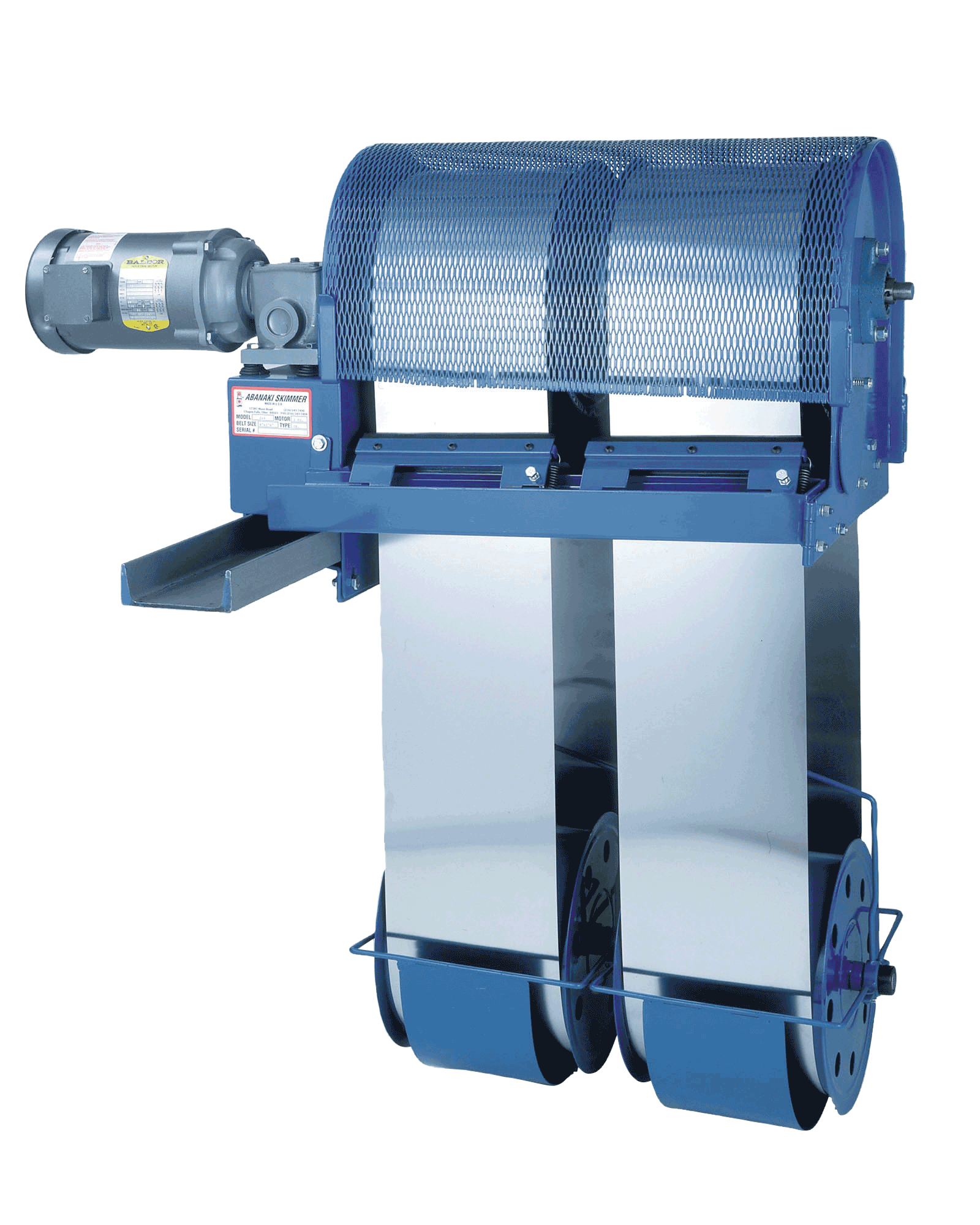
The Abanaki Model MB oil skimmer is a dependable and effective means of removing oil from water and water-base solutions. Often, oil skimming by itself will reduce oil to an acceptable level of water purity. Depending on the characteristics of the liquid, it is possible for the Model MB alone to reduce oil content to less than five parts per million in water. The unit can be used as a pretreatment before filtration, and in conjunction with a coalescing system.
Depending on the application, a belt skimmer such as the units described above can be used or a tube skimmer like the Oil Viper would be another viable solution. The Abanaki Oil Viper tube skimmer is a surface oil skimmer that effectively removes floating surface oils by means of an oleophilic (oil attracting) 3/4 inch diameter continuous looped tube. The tube extends out over the surface of the tank or pit and collects the free floating oils.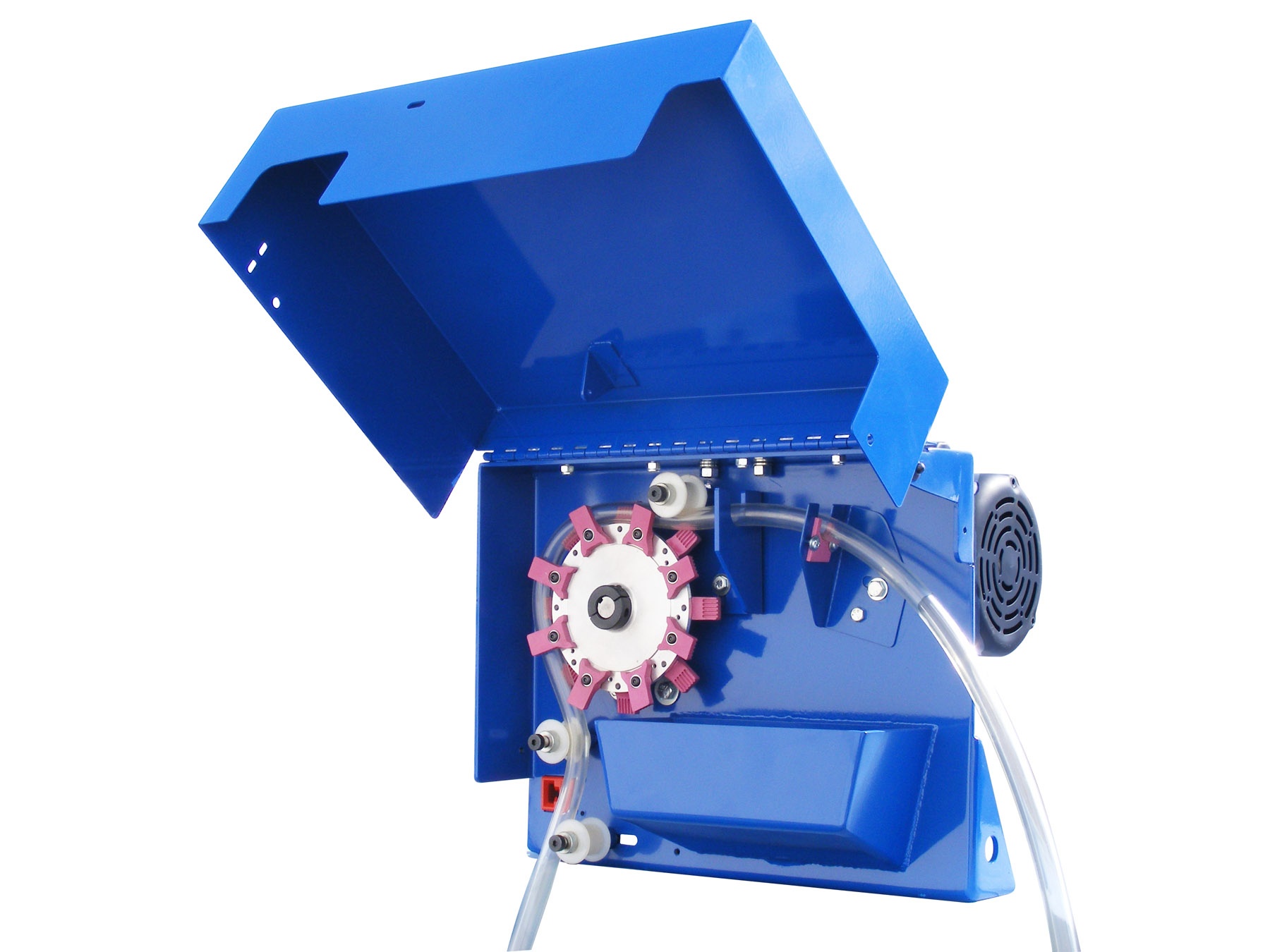
The Oil Viper has a specially designed method for removing the oil from the tube. It has a unique wiper combination attached to the tube itself in addition to the ceramic wiper on the skimmer. The result is a virtually oil free tube as it leaves the oil skimmer for quicker oil removal. Removal rates can be as high as one hundred gallons per hour. It can be used in either shallow tanks or reservoirs.
Read more