Half Sized Blog Element (Single Author Style)
Half Sized Blog Element (Multi Author Style)

Facts About Oil Skimming System Designs: Part 1

Choosing an Oil Skimmer by Removal Capacity | Abanaki

Facts About Oil Skimming System Designs: Part 1
Choosing an Oil Skimmer by Removal Capacity | Abanaki
Oil skimmers usually incur a low initial cost, install easily, offer rugged construction, reliable operation and minimal upkeep. Training personnel for operation, monitoring and routine maintenance is nil.
Still, there are different types of skimmers, and each application requires some analysis to make the best selection. Also, the water collection system must be set up properly in order to get maximum performance from the skimmer.
Reservoir Design
Because skimming acts on floating oil, the water must be in a reservoir where separation can occur. The reservoir should be designed with quiet areas, weirs and sufficient volume to allow adequate residence time for oil/water separation. Avoid turbulence by having water return to the reservoir below the liquid surface at as low a velocity as practical. Tanks without nooks and crannies for oil to accumulate in are best.
If you have an irregular shape, put the skimmer where the largest amount of oil accumulates. Consider a means of directing oil toward the skimmer medium to improve removal efficiency.
Turbulence
All skimmers work more efficiently in quiet water with a relatively thick oil layer. The greater the turbulence, the lower their efficiency due to emulsification. Turbulence also affects the physical performance of a skimmer. For example, a tube-shaped medium may get kinked due to turbulence, which could cause damage or impair its drive mechanism.
Mop type oil skimmers may require a tail pulley with its axle secured to the side of the tank. Belt types may be fitted with a tether or stabilizer bar assembly to resist twisting of the tail pulley.
Skimmer Reliability and Maintenance
Skimmers require a certain amount of routine maintenance, primarily periodic cleaning and checking wiper blade adjustment. Easy removal of safety covers shielding the moving medium and its pulleys will reduce maintenance time.
In terms of drive designs, those with separate gear reducers tend to be somewhat more robust than unitary gear motor drives. Chain drives, which are found on a few models, need to be lubricated regularly and the chain should be protected from debris and other impediments.
Installing an Oil Skimmer
The biggest installation issues are the amount of space required and cost. With regards to space, there are two areas that need to be considered: mounting area and water surface area. Installation of a suction skimmer also may involve sensors and a control box.
Moving medium skimmers require some sort of rigid mount on or near the reservoir. Some require the drilling of holes into the tank, which can be costly, depending on the reservoir design. Because of drive design, drum types tend to require more elaborate mounting methods and space. Belt, disk, tube and mop drive units consume a moderate amount of space.
An advantage of some belt skimmer drives is the use of a flat surface mount or bracket, neither of which require tank modifications. Mounting stands, brackets and adapters help make skimmer installations easier and faster.
Portability is a plus in some applications. For example, in plants and mobile equipment service shops, a portable skimmer can sometimes service both a parts washer and a drain water retention sump.
Belt and disk type skimmers tend to be the best designs for portability, and can be made small enough to weigh only a few pounds.
As most hydrocarbons spread fairly quickly over the top of water, it is not necessary to use more of the surface than the skimmer medium contact area. However, a skimmer’s design may actually take up more of the surface than the minimum required. A drum skimmer may require up to five square feet depending on drum size.
A tube skimmer requires four to five square feet due to the tube snaking out over the surface of the liquid. Unless a mop medium is constrained by a tail pulley, it moves around and takes up surface real estate. This is particularly true when there is turbulence.
Disk skimmers generally require from one-half to one square foot of liquid area.
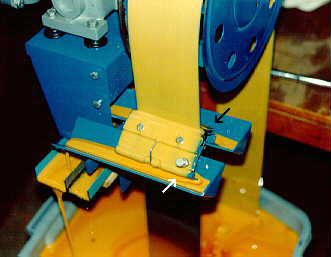
Belt skimmers require from a few square inches to about one square foot, which is determined by the belt width and diameter of the tail pulley.
To learn more about oil skimmers, please contact our experts at 440-543-7400 or visit our website: www.abanaki.com
Choosing an oil skimmer best suited for your application will maximize oil removal while minimizing capital outlay and oil skimming operation costs. In selecting an oil skimmer is to know what you need or expect your removal capacity to be.
Capacity should be based on the maximum amount of oil to be removed within the shortest available time. For instance, total oil influx may be 200 gallons in a 24 hour period, which averages about 8.3 gallons per hour. But if most of it comes during a single eight hour plant shift, you will probably need a removal rate that is three times as high, especially if you are trying to prevent an unwanted discharge of contaminated water to a sewer system. As a rule-of-thumb, specify approximately twice the maximum capacity you anticipate needing for normal conditions.
Check out our Oil Skimming Guide to learn more.
Rating
Oil skimmers usually have an oil removal rate expressed in gallons per hour. The rate varies with oil viscosity, so Abanaki rates skimmers using SAE 30 weight motor oil at 65°F (18°C). When specifying removal capacity, it is better to err on the high side to allow for peaks in the oil influx.
Water Content
All oil skimmers pick up some water with the oil they remove. Some designs, particularly suction skimmers, pick up more water than others. High water content increases oil recycling and disposal costs. Generally, the ratio of water-to-oil decreases with thicker films of floating oil and slower moving pick-up media. An Oil Concentrator® or decanter installed at the oil skimmer discharge port provides secondary oil/ water separation that can reduce water content to nearly zero.
Residual Oil
An oil skimmer continues to remove oils as long as they are present. Depending on oil influx rate and the oil skimmer’s removal rate, residual oil in the water may be as low as a few parts per million. When residual oil reaches this level and further reduction is required, it may be more practical to use a secondary removal method following skimming, such as membrane filtration.
Portability
Oil skimmer portability is a plus in some applications. For example, in plants, mobile equipment service shops, and at remediation sites, a portable oil skimmer can sometimes service multiple machines, sumps, or wells.
To learn more about oil skimmers, please contact our experts at 440-543-7400 or visit our website: www.abanaki.com

Have you ever looked at your coolant and wondered what type skimmer would work best in your machine sump? In this video, we talk about what oil skimmer works well in various coolant applications.

Abanaki Corporation Oil Skimming Division
17387 Munn Road
Chagrin Falls, OH 44023
Phone: (440) 543-7400
Email: skimmers@abanaki.com
Fax: (440) 543-7404
ISO 9001:2015 Certified Company
Terms and Conditions
Facts About Oil Skimming System Designs: Part 1| Abanaki
Facts About Oil Skimming System Designs: Part 1
Choosing an Oil Skimmer by Removal Capacity | Abanaki
Choosing an Oil Skimmer by Removal Capacity | Abanaki